
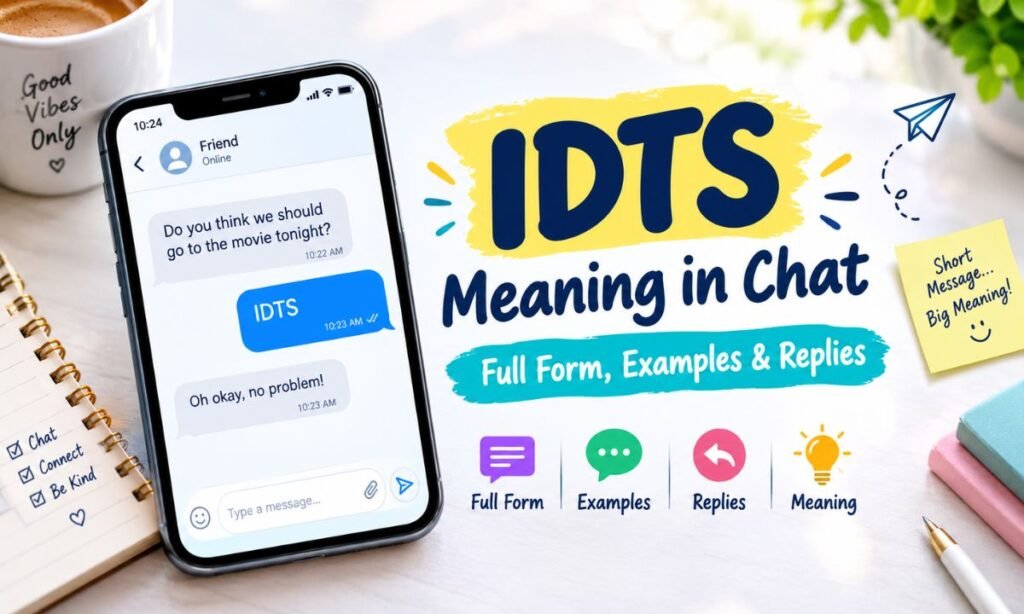
If you have seen IDTS pop up in a text thread and paused mid-scroll wondering what it means, you are not alone. It is one of those short-form replies that shows up constantly in casual messaging but rarely gets explained clearly.
In simple terms, IDTS stands for “I Don’t Think So.” It is a quick way to express doubt, mild disagreement, or a soft no without typing out a full sentence. Below, we break down its meaning, its tone, and how people actually use it across different chats and apps.
What Does IDTS Mean in Chat?
IDTS is a text-based initialism for “I Don’t Think So.” It is used when someone wants to express skepticism or a gentle negative response to a question or statement, rather than flatly refusing or disagreeing.
Unlike a hard “no,” IDTS carries a tone of uncertainty. The sender is signaling that something seems unlikely or incorrect to them, but they are leaving a little room for doubt. This makes it a popular choice in everyday texting because it softens the reply without losing the point.
Example: Friend: “Do you think it will rain tonight?” You: “IDTS.”
IDTS Full Form Explained
The full form of IDTS breaks down letter by letter as follows:
| Letter | Represents |
| I | I |
| D | Don’t |
| T | Think |
| S | So |
Put together, it reads “I Don’t Think So.” The phrase itself communicates a negative opinion, but one that is based on personal judgment rather than absolute certainty. It is closer to “I doubt it” than to a firm “no way.”
People lean on IDTS instead of typing the full phrase mainly because it saves time, fits naturally into fast back-and-forth conversations, and matches the informal rhythm of texting and chat apps.
How IDTS Is Used in Real Conversations
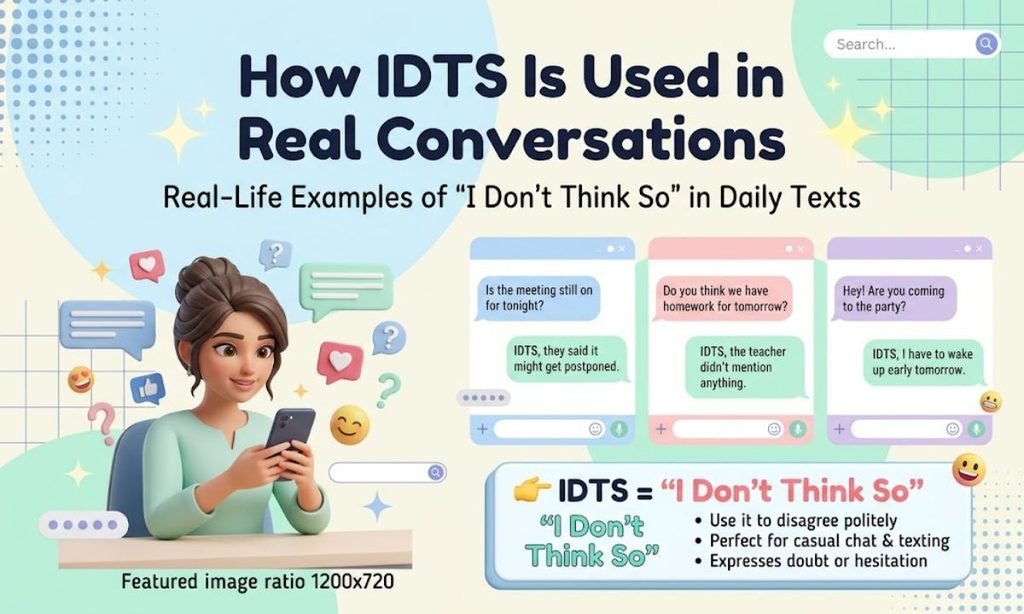
The meaning of IDTS stays consistent, but the situation shapes how it lands. Here are a few common contexts.
- Expressing uncertainty: “Is Sarah coming tonight?” — “IDTS, she hasn’t replied all day.”
- Disagreeing with an opinion: “That was the best movie of the year.” — “IDTS, the ending felt rushed.”
- Softening a no: “Want to grab dinner later?” — “IDTS, I’m pretty wiped out.”
- Playful or joking tone: “You’re definitely waking up at 6 AM.” — “IDTS.”
In each case, the core meaning stays the same, but punctuation, emojis, and the relationship between the two people change how blunt or friendly the message feels.
IDTS Across Different Messaging Apps and Platforms
IDTS is not tied to one platform. It shows up wherever quick, informal replies are common.
- WhatsApp: Frequently used in both one-on-one chats and group threads to respond fast without breaking the conversation flow.
- Instagram: Common in direct messages and comment replies, especially in reaction to opinions or predictions.
- Snapchat: Works well as a quick one-line reply to a snap or chat message.
- Discord and gaming chats: Often used mid-game or in server chats to react to a claim about strategy, timing, or outcomes.
The meaning does not change from app to app. What changes is the pace of the conversation and how much context surrounds the reply.
Is IDTS Rude, Friendly, or Neutral?
This is where a lot of confusion comes from. IDTS is not inherently rude, but a short reply can feel cold if there is no extra context.
Sounds friendly: “Think we’ll finish this today?” — “IDTS haha, we still have a lot left.” Sounds dismissive: “Do you even care?” — “IDTS.”
Punctuation and emojis also shift the tone. Compare “idts” in lowercase with no punctuation, versus “IDTS…” with trailing dots, versus “IDTS” followed by a laughing emoji. None of these have one fixed emotional meaning, but they all nudge the reader’s interpretation in a slightly different direction.
How to Reply to IDTS?
If someone sends you IDTS, your response usually depends on whether you want to push back, ask for clarification, or just move on.
Friendly replies:
- “Why not?”
- “Haha, we’ll see.”
- “Maybe you’re right.”
Replies asking for more detail:
- “Why do you think so?”
- “What happened?”
- “Can you explain?”
Polite replies in a serious conversation:
- “I understand your point.”
- “What makes you unsure?”
IDTS vs Other Common Chat Abbreviations
IDTS often gets mixed up with similar-looking texting shortcuts. Here is a quick comparison.
| Abbreviation | Full Form | Core Meaning |
| IDTS | I Don’t Think So | Doubt or mild disagreement |
| IDT | I Don’t Think | Incomplete opinion, needs more words |
| IDK | I Don’t Know | Lack of knowledge or certainty |
| IMO | In My Opinion | Personal viewpoint |
| TBH | To Be Honest | Honest or blunt statement |
The key difference between IDTS and IDK is worth noting: IDTS expresses doubt about a specific claim, while IDK expresses a genuine lack of knowledge. “No” is more direct than IDTS, since IDTS leaves room for being wrong.
The Origin and History of IDTS in Digital Slang
Like many texting abbreviations, IDTS grew out of early SMS culture in the 2000s, when character limits and slow typing on flip phones pushed people to shorten common phrases. As instant messaging and social platforms expanded, the abbreviation carried over naturally because it fit the same fast, informal tone that chat culture favors. It has stayed in steady use ever since, largely unchanged in meaning.
Common Mistakes People Make When Using IDTS
- Using it in formal settings: IDTS can come across as too casual for work emails or professional messages.
- Assuming the tone is obvious: Without emojis or extra words, IDTS can be misread as harsh even when it is not meant that way.
- Confusing it with IDT: IDT alone often needs a follow-up thought, while IDTS is a complete standalone response.
- Overusing it in serious conversations: A one-word reply to an emotional or important message can feel dismissive.
IDTS in Professional vs Casual Communication
IDTS fits naturally into texts, DMs, and informal group chats among friends. It is best avoided in workplace emails, client messages, or any conversation where clarity and professionalism matter. In those settings, a full sentence such as “I don’t think that approach will work” communicates the same idea without sounding abrupt.
Regional and Generational Differences in Using IDTS
While IDTS is widely understood across English-speaking chat culture, younger users on platforms like Snapchat and Discord tend to use it more casually and frequently, often paired with emojis or lowercase styling. Older users or more formal messengers may prefer the full phrase or a slightly longer alternative like “I don’t think that’s right.”
Similar Expressions That Mean the Same as IDTS
Several phrases carry a similar meaning and can be swapped in depending on tone:
- “I doubt it.”
- “I’m not so sure about that.”
- “Not likely, IMO.”
- “I don’t believe that’s correct.”
These alternatives work well when you want to soften or slightly formalize the same sentiment IDTS expresses.
When Should You Use IDTS?
Good situations:
- Casual conversations with friends
- Informal group chats
- Social media DMs
- Playful, low-stakes exchanges
Better to avoid:
- Formal emails
- Workplace communication
- Sensitive conversations where tone could be misread
Frequently Asked Questions
What does IDTS mean in chat?
IDTS means “I Don’t Think So.” It expresses doubt or a soft disagreement in casual texting.
What is the full form of IDTS?
The full form is “I Don’t Think So,” used to signal mild uncertainty or disagreement.
Is IDTS rude?
Not inherently. Its tone depends on punctuation, emojis, and the conversation’s context.
What is the difference between IDTS and IDK?
IDTS expresses doubt about a claim, while IDK expresses not knowing something at all.
Can IDTS be used in formal emails?
It is better to write the full phrase in formal or professional communication.
How should I reply to IDTS?
Try “Why not?”, “What makes you think that?”, or “Maybe you’re right.”
Does IDTS mean the same thing on every app?
Yes, its core meaning stays consistent across WhatsApp, Instagram, Snapchat, and Discord.
Conclusion
IDTS means “I Don’t Think So” and is a common way to express doubt or a soft no in casual chats. Its tone shifts based on punctuation, emojis, and context, so it works best in relaxed conversations rather than formal ones. When clarity matters, spelling out the full phrase is always the safer choice.
