

FYI is one of the most common short forms used in everyday digital communication, appearing in texts, emails, and workplace chats alike. It stands for “For Your Information” and is used whenever someone wants to pass along a detail without expecting a reply or action.
This guide breaks down the real meaning of FYI, how it changes tone depending on where it’s used, practical examples from texting and email, and answers to the most commonly searched questions about this abbreviation.
What Does FYI Mean?
FYI expands to “For Your Information.” It is used to share a fact, update, or reminder that the recipient should simply be aware of. Unlike urgent requests, an FYI message usually carries no obligation to respond or act right away.
What Is the Full Form of FYI?
The full form is “For Your Information.” It’s typically used as a lead-in phrase before sharing a short piece of news or a reminder.
Is FYI an Abbreviation or an Acronym?
FYI is technically an initialism, since each letter is pronounced individually rather than blended into one spoken word.
FYI Meaning in Texting and Chat Apps
In text messages and chat platforms like WhatsApp or iMessage, FYI works as a quick heads-up tag placed at the start of a message. It signals that what follows is informational rather than a question or a demand.
What Does FYI Mean in a Text Message?
In texting, FYI usually softens a statement, letting the receiver know the sender is simply sharing a fact, not asking for anything back.
Does FYI Mean “Just So You Know”?
Yes, functionally the two phrases are nearly interchangeable, though FYI is more compact and commonly used in fast typing situations.
Using FYI in Professional Emails
Workplace emails often use FYI in the subject line or opening line to flag that the message is for awareness only, not for action. This helps recipients quickly prioritize their inbox.
How Is FYI Used in a Subject Line?
Placing “FYI:” before a subject line tells the reader instantly that no reply is expected, saving time for busy professionals.
Is FYI Appropriate in Formal Emails?
FYI is widely accepted in semi-formal workplace emails, though very formal or client-facing communication may prefer a full phrase instead.
Real FYI Examples in Everyday Conversations
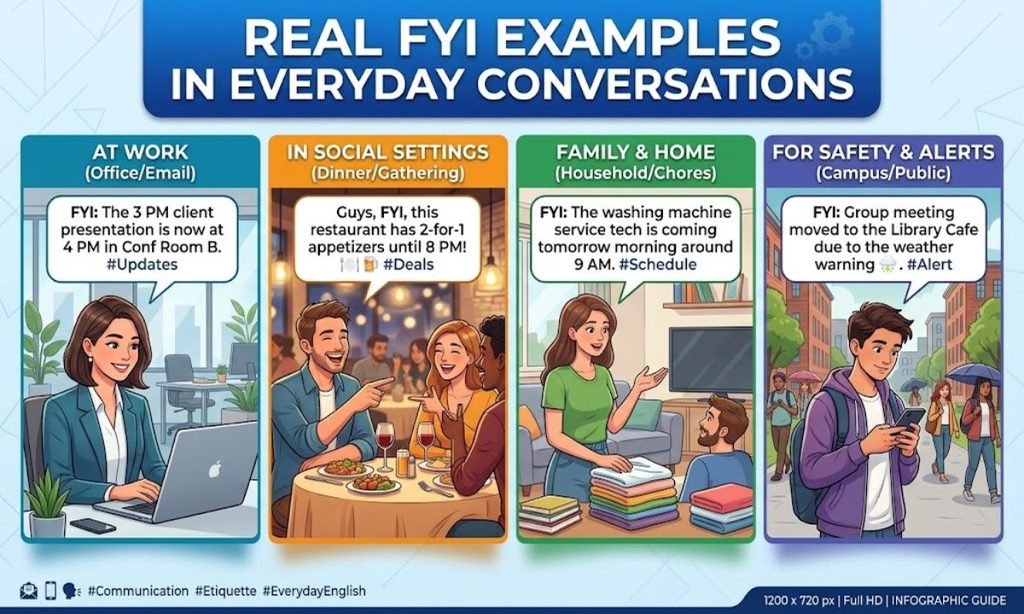
Seeing FYI in context makes its meaning clearer. Below are common situations where it naturally fits.
- Friends: “FYI, the movie starts at 7, not 8.”
- Work: “FYI, the client meeting was moved to Thursday.”
- Group chat: “FYI, I won’t be online after 9 tonight.”
- Email: “FYI — attaching the updated report for your records.”
- Family: “FYI, dinner’s ready whenever you’re free.”
Each example shows the same pattern: a short fact shared without pressure for a reply.
Does FYI Sound Rude or Passive-Aggressive?
FYI itself is neutral, but tone depends heavily on surrounding words, punctuation, and context. A blunt one-word FYI message can occasionally feel curt.
| Tone Type | Example | How It Feels |
| Neutral | “FYI, the file is uploaded.” | Informative, calm |
| Friendly | “Just an FYI, thought you’d want to know!” | Warm, casual |
| Firm | “FYI, this was already discussed.” | Slightly pointed |
| Sharp | “FYI.” (alone, no context) | Cold, abrupt |
Can FYI Sound Passive-Aggressive?
Yes, when used alone or after a disagreement, FYI can read as a subtle jab rather than plain information sharing.
When Does FYI Feel Most Natural?
FYI feels most natural when it introduces genuinely new, useful information the other person wouldn’t otherwise know.
Correct Ways to Use FYI in a Sentence
FYI usually sits at the very beginning of a sentence, followed by a comma, though it can also appear mid-sentence in casual writing.
Should FYI Be Capitalized?
FYI is traditionally written in capital letters since it’s an initialism, though lowercase “fyi” is common in casual texting.
Do You Need a Comma After FYI?
A comma after FYI is standard practice, as in “FYI, the deadline changed,” though many casual texters skip it.
How to Respond When Someone Sends FYI
Because FYI messages rarely require deep replies, short acknowledgments work best in most situations.
- “Thanks for letting me know.”
- “Got it, appreciate the heads-up.”
- “Noted, thank you.”
- “Good to know, thanks!”
- “Thanks for the update.”
Do You Have to Reply to an FYI Message?
No, a reply isn’t required, though a brief acknowledgment is considered polite in most conversations.
FYI in Business and Corporate Communication
Corporate teams use FYI constantly in internal memos, project updates, and CC’d emails to distinguish informational notes from action items requiring approval.
Why Do Companies Use FYI So Often?
Businesses rely on FYI to reduce email clutter, helping employees instantly separate updates from tasks needing a decision.
Common Mistakes People Make When Using FYI
Some writers overuse FYI or attach it to messages that actually require a response, causing confusion.
- Using FYI for urgent requests instead of clear action words.
- Sending FYI without any real new information attached.
- Overusing FYI repeatedly in the same conversation thread.
Is Overusing FYI a Problem?
Yes, repeated FYI tags can make messages feel robotic or reduce their impact when genuinely important updates appear.
FYI Meaning Across Different Generations
Older professionals often reserve FYI for formal memos, while younger users apply it casually in texts, DMs, and social captions.
Do Younger Users Interpret FYI Differently?
Younger users often treat FYI as conversational filler, while older users treat it strictly as a formal information marker.
FYI Compared to Similar Abbreviations
| Term | Meaning | Common Use |
| FYI | For Your Information | Sharing a fact or update |
| BTW | By The Way | Adding a side note |
| FYR | For Your Reference | Sharing a document or resource |
| ASAP | As Soon As Possible | Requesting urgency |
| JFYI | Just For Your Information | Casual informational note |
What’s the Difference Between FYI and BTW?
FYI introduces a standalone fact, while BTW usually adds a related side comment to an ongoing topic.
Alternatives to FYI You Can Use
For those wanting variety, several phrases carry the same informational tone as FYI.
- “Just so you know”
- “Heads up”
- “For your records”
- “Quick note”
- “Just letting you know”
Which Alternative Sounds Most Professional?
“For your records” and “quick note” tend to sound slightly more polished in formal workplace writing than casual alternatives.
Where Is FYI Commonly Used?
FYI appears across nearly every digital communication channel today, from personal chats to corporate systems.
- Text messages and instant messaging apps
- Work emails and internal memos
- Group chats and team collaboration tools
- Social media captions and comments
- Customer service and support tickets
History and Origin of FYI
FYI is believed to have originated in early twentieth-century office memos and journalism, where writers needed a quick way to flag background information. It later spread into everyday digital communication as texting and email became dominant.
When Did FYI Become Popular in Texting?
FYI gained widespread texting popularity alongside the rise of SMS and instant messaging in the late 1990s and 2000s.
Why FYI Remains Popular in Digital Communication
FYI survives because it’s short, universally understood, and works across almost every platform without needing explanation.
Will FYI Stay Relevant in Future Communication?
Yes, its brevity and clarity make it likely to remain a staple abbreviation even as digital communication trends evolve.
Frequently Asked Questions
What does FYI mean in text?
FYI means “For Your Information,” used to share a fact without expecting a reply.
What does FYI stand for?
It stands for “For Your Information,” a common informational abbreviation.
Is FYI rude?
Not inherently, though tone and context can make it feel blunt or curt.
Does FYI need a reply?
No, but a short acknowledgment is considered polite.
Is FYI professional?
Yes, it’s widely used in workplace emails and internal communication.
What’s a good alternative to FYI?
“Just so you know” or “heads up” work as natural alternatives.
Can FYI start a sentence?
Yes, it’s most commonly placed at the very start, followed by a comma.
Conclusion
FYI remains one of the simplest yet most useful abbreviations in modern communication, bridging texting, email, and workplace conversations with a single purpose: sharing information without pressure. Understanding its tone, correct placement, and common alternatives helps you use it naturally and appropriately across any platform.
