

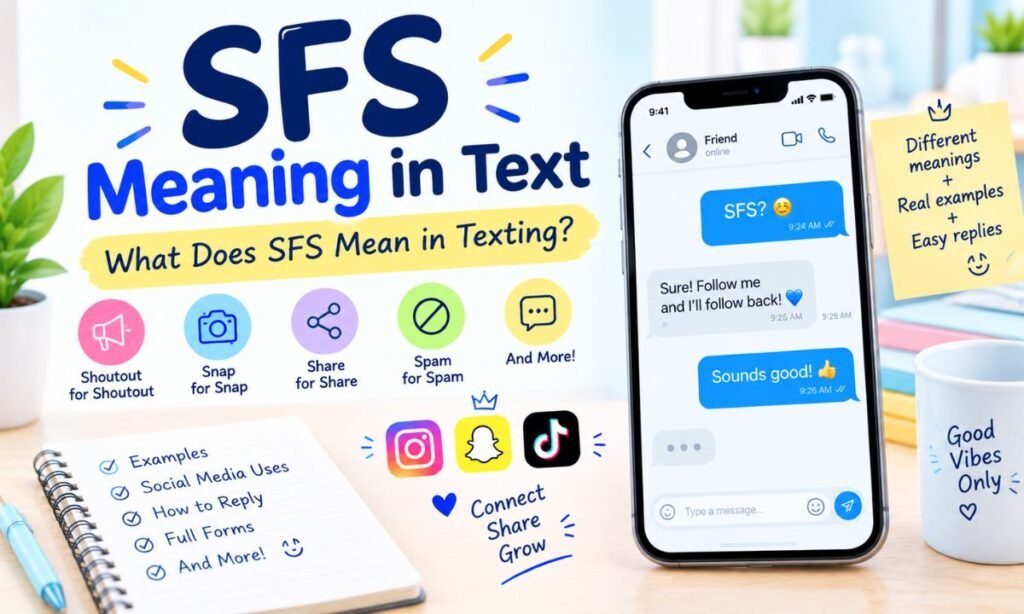
If you have seen “SFS” in a text, a Snapchat story, or an Instagram comment, you are not alone in wondering what it means. In most casual conversations, SFS stands for “shoutout for shoutout,” a common social media practice where two people promote each other’s accounts to grow their following.
The tricky part is that SFS does not always mean the same thing everywhere. Depending on the platform and the person sending it, it can also mean snap for snap, share for share, or even spam for spam. This guide breaks down every common meaning, shows real text examples, and explains how to reply naturally.
What Does SFS Mean in Text?
SFS most commonly means “shoutout for shoutout.” It describes a simple exchange where one person promotes another person’s account, page, or post in return for the same favor. The core idea behind almost every version of SFS is mutual promotion.
SFS usually means shoutout for shoutout
When someone texts “SFS?” they are typically asking if you want to promote each other’s accounts to gain more followers or visibility.
What does SFS mean in simple English?
In plain terms, SFS means “I’ll support you if you support me,” usually applied to social media growth.
Why does the meaning of SFS depend on context?
The exact meaning shifts based on the platform and conversation, since Snapchat, Instagram, and casual texting each use SFS slightly differently.
What Does SFS Stand For?
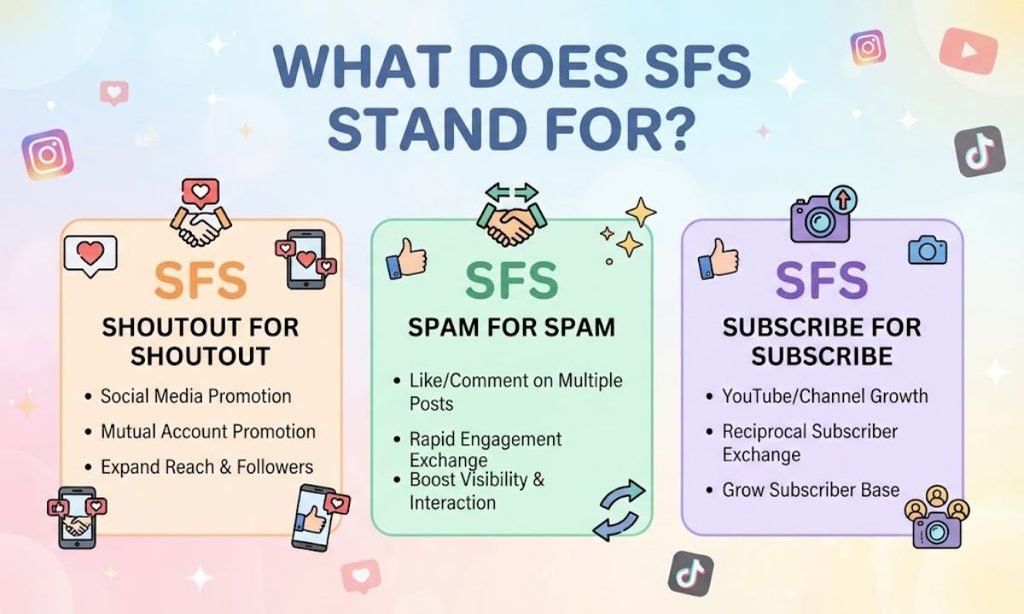
SFS has a few possible expansions, though one meaning dominates most everyday use.
| Expansion | Meaning | How Common It Is |
| Shoutout for Shoutout | Promote each other’s accounts | Most common meaning |
| Snap for Snap | Exchange Snapchat snaps | Common on Snapchat |
| Share for Share | Repost or share each other’s content | Fairly common |
| Spam for Spam | Comment repeatedly on each other’s posts | Less common |
| So Freaking Serious | Emphasizing seriousness | Rare, context dependent |
SFS Meaning in Different Situations
The intent behind SFS becomes clearer once you look at the surrounding conversation.
- When someone wants a shoutout, they are usually asking to be featured on your story or page
- When someone wants to exchange snaps, SFS is being used as a Snapchat specific request
- When someone wants to share content, SFS refers to reposting rather than tagging
- In a plain casual text, SFS often just means a general request to support each other online
How Does SFS Work on Social Media?
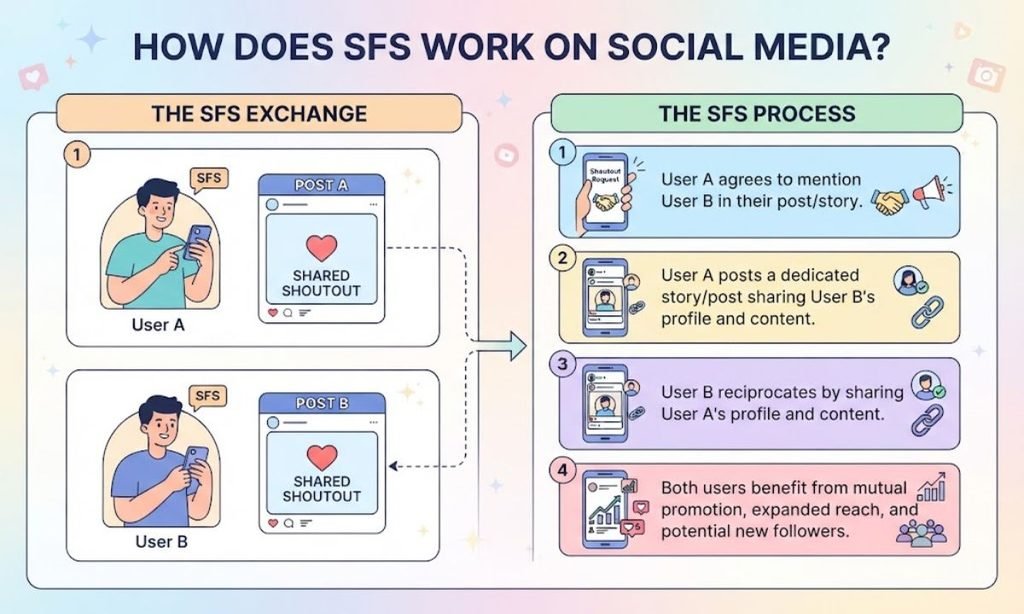
The mutual promotion idea behind SFS follows a simple pattern that repeats across almost every platform.
- One person agrees to feature or promote the other’s account
- The other person returns the favor with their own post, story, or shoutout
- Both audiences get introduced to a new account
- Followers and engagement increase for both people involved
This exchange works because it gives smaller accounts a quick way to reach a new audience without paid promotion.
What Does SFS Mean on Snapchat?
Snapchat is one of the platforms where SFS shows up most often, and it usually carries one of two meanings.
- “SFS? Send me your snap” typically means snap for snap
- “SFS? I’ll post your account on my story” typically means shoutout for shoutout
- Reading the rest of the message usually clarifies which version is meant
- If it is unclear, asking directly is completely normal
What Does SFS Mean on Instagram?
On Instagram, SFS almost always refers to shoutout for shoutout rather than snap exchanges.
- In Stories, it usually invites followers to tag accounts for a feature
- In DMs, it often starts a direct one on one shoutout arrangement
- In comments, it can be a quick request like “Anyone want to do SFS?”
- For growing accounts, SFS is a common, low cost way to gain new followers
What Does SFS Mean on TikTok?
On TikTok, SFS generally follows the same shoutout for shoutout idea, applied to videos instead of static posts.
- In comments, it often means a request to feature each other’s videos
- In messages, it can refer to sharing or promoting a specific clip
- Some creators use SFS loosely to mean simply sharing content with a wider audience
SFS Meaning in Text Messages and Chats
Outside social apps, SFS can appear in ordinary text threads too, usually carrying the same underlying idea.
| Message | Likely Meaning |
| “SFS?” | Asking if you want to exchange shoutouts |
| “Wanna do SFS?” | Suggesting a shoutout or promotion trade |
| “Anyone up for SFS?” | Open invite for anyone willing to promote each other |
| “DM me for SFS” | Asking people to message privately to set up the exchange |
| “Let’s do SFS on my story” | Suggesting a shoutout specifically on Stories |
Real SFS Text Examples With Meaning
Seeing the phrase used naturally often clears up confusion faster than a plain definition.
- “SFS?” means are you interested in trading shoutouts
- “Wanna do SFS?” means would you like to promote each other’s accounts
- “DM me for SFS” means message me privately to arrange the trade
- “SFS tonight?” means suggesting the exchange happen later that day
How to Reply When Someone Says SFS
Your reply depends on whether you want to take part in the exchange.
- If you want to do it, try “Sure, send me your username” or “Yeah, let’s do it”
- If you need clarity, ask “Do you mean shoutout for shoutout?”
- If you are not interested, a simple “Not right now, but thanks” works fine
- Keeping the reply short and friendly matches the casual tone of the original message
Is SFS a Good or Bad Thing?
SFS is generally a neutral, friendly practice, though the tone can shift depending on how it is used.
- It is usually positive when both sides genuinely benefit from the exchange
- It can feel spammy when accounts request SFS excessively or from strangers
- Repeated, low effort SFS requests are sometimes seen as annoying rather than helpful
- Most people view occasional SFS exchanges as a normal part of growing a social presence
What Does SFS Mean From a Guy or a Girl
The meaning of SFS does not usually change based on gender, since it is rooted in social media growth rather than personal relationships.
- From a guy, SFS is typically about promotion, not flirting
- From a girl, the meaning stays largely the same unless the conversation already has a romantic tone
- SFS is not automatically flirty, though surrounding messages can sometimes add that layer
- If romantic intent is present, it usually shows through other cues, not the abbreviation itself
SFS vs Other Social Media Abbreviations
SFS is often mentioned alongside similar reciprocal growth terms, so it helps to see how they differ.
| Abbreviation | Meaning | Main Difference From SFS |
| F4F | Follow for follow | Focused only on following, not content promotion |
| L4L | Like for like | Focused on liking posts rather than shoutouts |
| Share for Share | Reposting content | A specific version of SFS itself |
| Snap for Snap | Exchanging snaps | Platform specific version limited to Snapchat |
Is SFS Appropriate to Use Everywhere?
SFS fits naturally into casual texting and social media, but it is not suited for formal communication.
- It works well in DMs, comments, and casual group chats
- It should be avoided in professional emails or workplace messaging
- SFS is not considered rude, just informal
- In formal settings, phrases like “cross promotion” or “mutual feature” work better
Common Misunderstandings About SFS
A few mix ups come up often enough to be worth clearing up directly.
- Assuming SFS always means the exact same thing across every platform
- Confusing snap for snap with shoutout for shoutout without checking context
- Treating every SFS request as spam, when many are genuine growth exchanges
- Missing the difference between a one time SFS and an ongoing content swap
How SFS Exchanges Are Usually Set Up
Most SFS arrangements follow a predictable, informal process rather than a strict rulebook.
- One account reaches out, often through a comment or direct message
- Both sides agree on the format, such as a story post or a feed post
- The shoutout is posted, tagging the other account clearly
- The favor is returned within a similar timeframe, usually the same day
Tips for a Successful SFS Exchange
A few small habits make these trades more effective for everyone involved.
- Only agree to SFS with accounts that share a similar audience or niche
- Set clear expectations about timing and format before agreeing
- Use genuine, well written captions instead of generic copy paste text
- Avoid overdoing SFS requests, since quality exchanges work better than quantity
Where Did SFS Come From?
SFS grew out of earlier social media habits where users would tag or mention each other to boost visibility, long before formal advertising tools existed on most platforms. As Instagram, Snapchat, and later TikTok expanded, the shorthand became a quick, standardized way to request the same kind of mutual support.
There is no single confirmed origin point, but its steady use over the years reflects how creators and casual users alike continue to rely on it for organic growth.
Frequently Asked Questions
What does SFS mean in text?
SFS usually means shoutout for shoutout, a request to promote each other’s accounts.
What does SFS stand for?
It most often stands for shoutout for shoutout, though it can also mean snap for snap or share for share.
What does SFS mean on Snapchat?
On Snapchat, SFS can mean either snap for snap or shoutout for shoutout, depending on the message.
What does SFS mean on Instagram?
On Instagram, SFS almost always means shoutout for shoutout between two accounts.
What does SFS mean on TikTok?
On TikTok, SFS usually refers to promoting or featuring each other’s videos.
How do you reply to SFS?
You can agree with something like “Sure, send your username,” ask for clarification, or politely decline if you are not interested.
Is SFS flirty?
Not typically. SFS is mainly about social media promotion rather than romantic interest, unless the surrounding conversation suggests otherwise.
Conclusion
SFS is a simple, widely used piece of social media shorthand built around one core idea: mutual support. Whether it means shoutout for shoutout, snap for snap, or share for share, the underlying goal stays the same, helping two accounts grow together. Once you know the platform and read the surrounding message, figuring out exactly what someone means becomes easy.
